

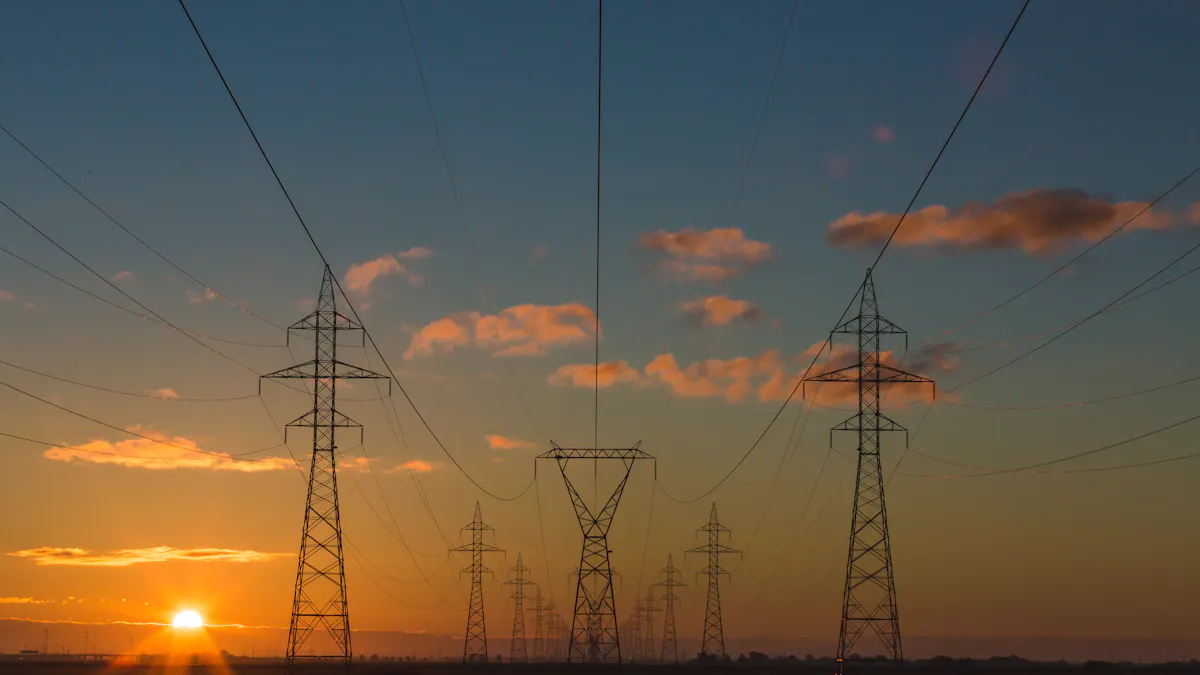
The Union Cabinet has approved Green Energy Corridor Phase III with a ₹1,86,405 crore outlay to strengthen intra-state transmission and add large-scale battery storage capacity. The programme is designed to evacuate up to 135 GW of renewable power by 2032-33. Of the total, ₹1,36,378 crore is earmarked for transmission systems and ₹50,000 crore for 50 GWh of battery energy storage.
India has approved its biggest new grid-infrastructure programme for renewable power this year, pairing interstate-scale ambition with state-level execution. The September 30 Cabinet decision puts transmission lines, substations and battery storage into one programme intended to help state grids absorb rapidly growing solar and wind generation.
What Happened
The Union Cabinet approved Green Energy Corridor Phase III, or GEC-III, with a total outlay of ₹1,86,405 crore. The scheme is designed to evacuate up to 135 GW of renewable energy across states and Union Territories by 2032-33.
The approved spending has two main components: ₹1,36,378 crore for intra-state transmission systems and ₹50,000 crore for 50 GWh of battery energy storage systems. The programme includes ₹54,082 crore of central financial assistance, according to details reported by United News of India and corroborated by Moneycontrol.
The plan covers 51,126 circuit kilometres of transmission lines and 2,28,903 MVA of transformation capacity. State Transmission Utilities will be the overall implementing agencies. Greenfield projects are expected to use tariff-based competitive bidding, while brownfield upgrades will follow a cost-plus route.
Why It Matters
Adding renewable generation is only useful if the grid can carry that power to demand centres. Solar and wind output also changes by hour and season, creating a need for flexible transmission and storage. GEC-III addresses both problems: new lines and substations expand carrying capacity, while batteries can absorb surplus power and release it when renewable output falls.
The 50 GWh storage allocation is significant because it puts battery systems inside a transmission programme rather than treating them as a separate pilot. If procurement and execution stay on schedule, the combination could reduce congestion, curtailment and the mismatch between new renewable projects and grid readiness.
Market Impact
There was no demonstrated share-price move attributable specifically to the Cabinet approval by the time of publication. The policy creates a future project pipeline for transmission developers, engineering contractors, substation-equipment makers and battery suppliers, but benefits will depend on detailed tenders, state allocations, competitive bids and actual contract awards.
Investors should therefore distinguish the headline outlay from immediately addressable revenue. The central assistance is public support for the programme; it is not an order book for any listed company.
Industry Context
India’s renewable build-out increasingly requires grid investment to move power from resource-rich regions to consumption centres. Moneycontrol reported that the programme is expected to leverage about ₹1.32 lakh crore of transmission investment, while the renewable capacity associated with it could involve substantially larger generation investment. Those are programme estimates, not guaranteed spending by specific companies.
GEC-III follows earlier Green Energy Corridor phases and adds much larger storage and network ambitions. Its 2032-33 completion target also makes execution discipline important: land access, state clearances, equipment supply, tender design and coordination between generators and transmission utilities will determine how quickly the announced capacity becomes usable.
What To Watch Next
- The state-wise list of approved transmission and battery-storage projects.
- Detailed bidding calendars, eligibility rules and award announcements.
- The split between new greenfield networks and upgrades to existing systems.
- Milestones for transmission lines, substations and BESS commissioning.
- Whether central support contains transmission charges without delaying procurement.
FAQs
What is Green Energy Corridor Phase III?
Green Energy Corridor Phase III is a national programme to expand intra-state electricity transmission and battery storage. It is intended to connect renewable generation more reliably with state grids, reduce bottlenecks and give the system more flexibility when solar or wind output changes.
How is the ₹1.86 lakh crore outlay divided?
The approved outlay is ₹1,86,405 crore. Of this, ₹1,36,378 crore is for intra-state transmission systems and ₹50,000 crore is for 50 GWh of battery energy storage. The government has also approved ₹54,082 crore in central financial assistance across the programme.
Will the scheme reduce electricity bills?
Not immediately. The scheme is infrastructure support, not a direct retail tariff cut. Better transmission and storage may reduce congestion and renewable-power curtailment over time, while central assistance is intended to limit transmission costs. Actual consumer impact will depend on implementation, procurement costs and state regulation.
Sources
- Press Information Bureau: Cabinet approval — September 30, 2026
- United News of India: Scheme details — September 30, 2026
- Moneycontrol: Transmission and storage breakdown — September 30, 2026